
History of Bajaj Auto: From Chetak Scooters to Global Giant
Trace Bajaj Auto's dramatic evolution from importing vehicle parts to becoming a global motorcycle powerhouse powered by Chetak, Pulsar, KTM, and Triumph.
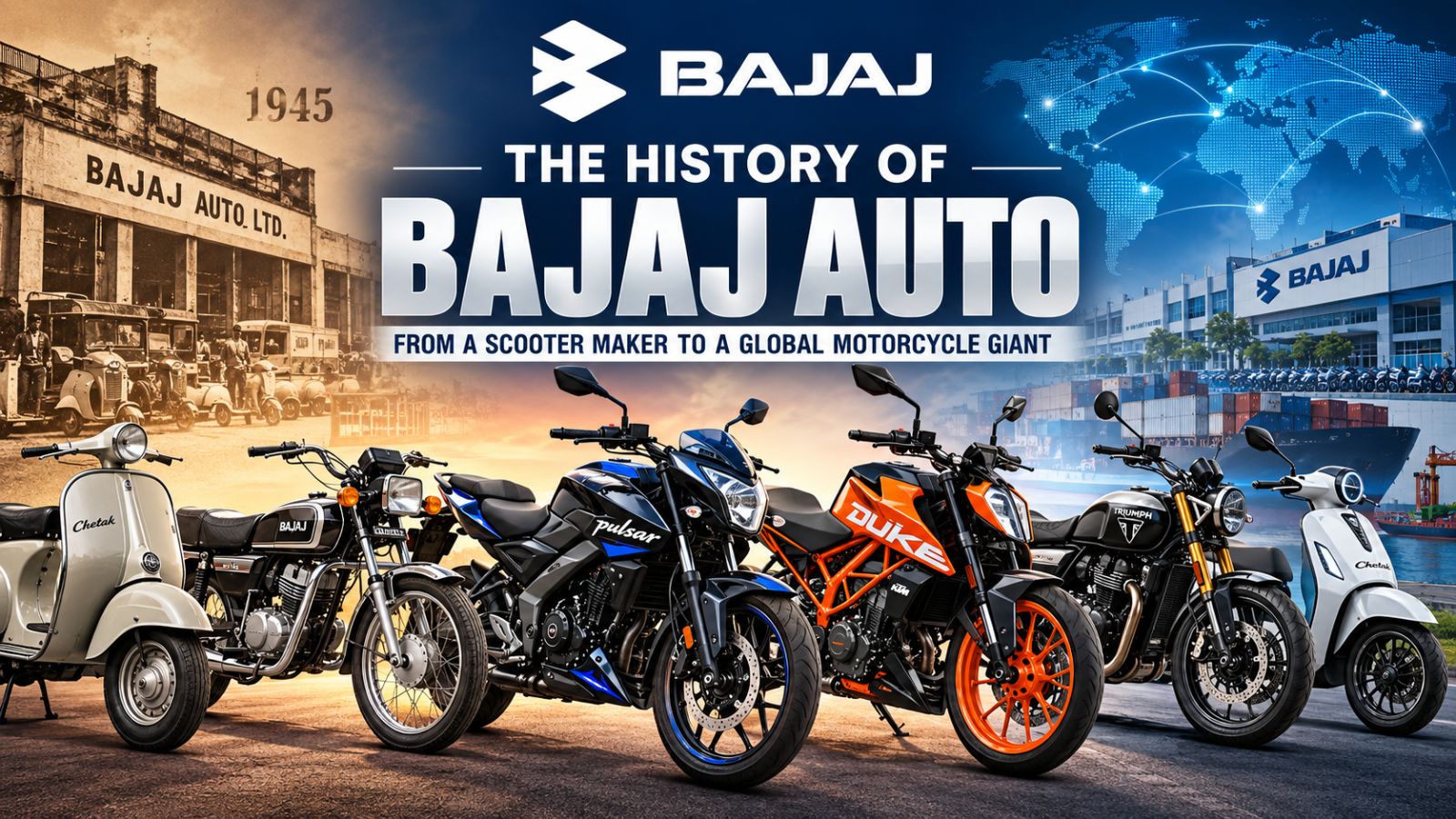
If you grew up in India during the 1980s, the soundtrack of Sunday morning was the rhythmic thump-thump of a Bajaj Chetak being tilted to one side to catch a spark. It wasn't just a two-wheeler; it was the family sedan, the office commute, and the pride of the middle class. Fast forward to today, and that same Indian brand isn't just powering neighborhood commutes—it manufactures razor-sharp KTM naked bikes exported to Europe, crafts modern-classic Triumph roadsters for global riders, and ships two-wheelers to over 70 countries. Bajaj Auto’s story isn't a straight line of steady growth. It's a masterclass in strategic reinvention, marked by daring shifts from trading to manufacturing, scooters to performance motorcycles, and domestic dominance to global ownership.
Bajaj Auto’s Early Years: From Trading to Manufacturing
Long before the assembly lines roared, the Bajaj Group’s automotive footprint began in 1945 under the visionary leadership of Jamnalal Bajaj. Operating initially as M/s Bachhraj Trading Corporation Ltd., the company started by importing and selling two- and three-wheelers in India still finding its economic footing.
Recognizing that a newly independent nation needed accessible, localized transport, the company secured a manufacturing license in 1959. A public listing followed in 1960. This pivotal transition from importing finished components to localized manufacturing allowed Bajaj to tap into India's exploding post-independence demand for personal mobility, setting the stage for an industrial legacy.
The Vespa Connection and the Rise of Bajaj Chetak
The Vespa Licensing Era
In 1960, Bajaj struck a crucial license agreement with Piaggio, the Italian creator of the iconic Vespa. Producing Vespa scooters under license provided Bajaj with world-class engineering know-how, precise sheet-metal stamping capabilities, and factory-floor discipline. When the license expired in 1970, Bajaj didn't look back—it took those technical learnings and launched its own line.
1945: Founded as Bachhraj Trading
Started by importing two- and three-wheelers into post-war India.
1960: Piaggio Licensing Deal
Began producing Vespa-based scooters and gained engineering scale.
1972: The Birth of Chetak
Launched the iconic metal-bodied Chetak, named after Maharana Pratap's legendary warhorse.
The Birth of an Icon: Bajaj Chetak
Named after Maharana Pratap’s legendary warhorse, the Bajaj Chetak hit the market in the early 1970s and instantly captured the nation’s imagination. Built like a tank with a full-metal body and an indestructible two-stroke engine, the Chetak carried entire families and survived India's toughest roads.
Waitlists stretched to over a decade; a Chetak was even prized as an essential wedding dowry item. Immortalized by the iconic "Hamara Bajaj" jingle, it became the ubiquitous symbol of Indian middle-class aspirations.
Why Bajaj Had to Move Beyond Scooters
By the late 1990s, the Indian economic landscape was shifting rapidly. Economic liberalization brought new choices, a younger demographic, and changing priorities. Commuters began demanding better fuel efficiency, smoother four-stroke engines, and sportier styling—areas where four-stroke motorcycles excelled over traditional two-stroke, metal-bodied scooters.
With nimble Japanese joint ventures making heavy inroads, Bajaj faced an existential choice: cling to its declining scooter monopoly or pivot aggressively to motorcycles.
Kawasaki Partnership: Entering the Modern Motorcycle Era
To accelerate its shift toward motorcycles, Bajaj forged a strategic alliance with Japan's Kawasaki in the 1980s. This partnership introduced Indians to crisp, performance-driven machines like the KB100 and the popular 4S Champion.
More importantly, the technical collaboration acted as a crucible for Bajaj's internal R&D. Japanese engineering discipline, precise manufacturing standards, and four-stroke engine technology laid the technical groundwork Bajaj required to eventually build its own proprietary motorcycles.
Pulsar: The Motorcycle That Changed Bajaj Auto
By 2001, the motorcycle market was flooded with sensible, 100cc commuter bikes prioritizing mileage over thrill. Bajaj decided to throw out the playbook.
The 2001 Revolution
Launched in November 2001 with its famous "Definitely Male" campaign, the Bajaj Pulsar (150cc and 180cc) shattered the commuter mold. Featuring muscular fuel tanks, disc brakes, bold stances, and raw power, it democratized performance riding for Indian youth.
+-----------------------------------------------------------------------+
| THE PULSAR TRANSFORMATION |
+------------------------------------+----------------------------------+
| BEFORE PULSAR (Pre-2001) | AFTER PULSAR (Post-2001) |
+------------------------------------+----------------------------------+
| Known primarily for family scooters| Recognized as a youth performance|
| Focus on basic 100cc commuters | Pioneer of accessible sports bikes|
| Dependent on licensed tech | Powered by patented DTS-i engine |
+------------------------------------+----------------------------------+
Why Pulsar Was the Ultimate Turning Point
Tech-Led Innovation: Introduction of patented DTS-i (Digital Twin Spark-Ignition) technology balanced high power output with strong fuel economy.
Brand Image Overhaul: Shifted Bajaj from a "father's scooter company" to a youthful, performance-oriented brand.
Scalable Platform: Evolved into a vast lineup ranging from 125cc everyday sport commuters to 250cc flagships, dominating domestic sales and leading export rosters.
Bajaj Goes Global: From Indian Manufacturer to Export Powerhouse
With a strong domestic foundation, Bajaj turned its eyes outward. Utilizing its state-of-the-art manufacturing plant in Chakan, Maharashtra, Bajaj combined high manufacturing scale with precise cost control.
By pushing heavy-duty commuter models like the Boxer into Africa and the Pulsar series into Latin America and Southeast Asia, Bajaj quickly established itself as India's top two-wheeler exporter. Today, nearly half of its two-wheeler production leaves Indian shores, and its commercial three-wheelers dominate urban transport across developing markets globally.
KTM Partnership: Entering the Premium Performance World
In 2007, Bajaj took a bold step by acquiring a 14.5% stake in struggling Austrian motorcycle maker KTM. Rather than acting as a passive investor, Bajaj turned the arrangement into a symbiotic industrial powerhouse.
Manufacturing Synergies: Bajaj moved the production of smaller-displacement KTM Dukes and RC series (125cc to 390cc) to its Chakan facility, cutting production costs drastically while maintaining European quality.
Global Footprint: Lower pricing allowed KTM to expand exponentially worldwide, becoming Europe's largest motorcycle manufacturer.
Deepening Control: Over the years, Bajaj steadily increased its economic stake, consolidating its ownership framework and gaining unprecedented access to high-end performance engineering.
Dominar, Triumph, and Chetak EV: New Frontiers
Bajaj’s appetite for expansion hasn't slowed down, pushing into larger displacements, premium legacy brands, and clean energy.
Dominar 400 (2016): Marked Bajaj's entry into the long-distance sports-touring segment, offering premium, power-packed touring capability at an accessible price.
Chetak EV (2019): Reimagined the legendary Chetak nameplate as a sleek, premium electric scooter, bridging nostalgia with zero-emission city transit.
Triumph Partnership: Partnering with iconic British brand Triumph, Bajaj co-developed and manufactured the Speed 400 and Scrambler 400 X. These modern-classics opened up premium mid-capacity riding to a global audience.
[Bajaj Auto Multi-Brand Strategy]
|
+------------------+------------------+
| |
[Mass & Performance] [Global Premium]
Pulsar Series KTM (Engineered/Built at Chakan)
Dominar 400 Triumph (Speed 400 / Scrambler)
Freedom 125 (CNG) Chetak EV
Freedom 125 and Alternative Fuels
In 2024, Bajaj disrupted the utility market once again by launching the Freedom 125—the world’s first production CNG-powered motorcycle. Engineered with an integrated dual-fuel (CNG + Petrol) tank system, it offers dramatically lower running costs and reduced emissions, proving Bajaj’s commitment to alternative fuel strategies beyond standard electric mobility.
Key Takeaways
1945 Origins: Started as an importer and trader before obtaining manufacturing licenses.
Vespa Roots: Built engineering foundation through a licensed partnership with Piaggio.
Chetak Legacy: Created an iconic household brand that dominated Indian personal transport for decades.
Motorcycle Pivot: Courageously abandoned a declining scooter monopoly to embrace four-stroke motorcycles.
Pulsar Impact: Redefined the Indian motorcycle market in 2001 with accessible performance.
Global Footprint: Built an export empire spanning Africa, Latin America, and Asia.
Strategic Partnerships: Leveraged alliances with Kawasaki, KTM, and Triumph to master engineering at every level.
Future-Proofing: Pioneered new segments with the Chetak EV and the Freedom 125 CNG.
Conclusion: The Evolution of Bajaj Auto
The trajectory of Bajaj Auto is a story of continuous adaptability. Very few companies successfully walk away from the product that built them, yet Bajaj abandoned its lucrative scooter monopoly when market realities shifted. By transitioning from licensed assembler to independent innovator, from domestic supplier to global exporter, and from scooter maker to a major player in KTM and Triumph's global journeys, Bajaj Auto has proven that its true strength isn't just manufacturing iron and steel—it's navigating change.
Frequently Asked Questions About Bajaj Auto's History
1. When was Bajaj Auto founded?
Bajaj Auto was originally established in 1945 as Bachhraj Trading Corporation Ltd., later shifting to vehicle manufacturing in 1959.
2. What was Bajaj Auto's first major two-wheeler?
Its first major manufactured two-wheelers were Vespa-derived scooters built under license from Italy's Piaggio during the 1960s.
3. When was the Bajaj Chetak launched?
The Bajaj Chetak was officially introduced in the early 1970s following the end of Bajaj's licensing arrangement with Piaggio.
4. Why was the Bajaj Chetak so popular?
It offered unmatched durability, low maintenance, and room for the whole family, earning legendary status under the "Hamara Bajaj" banner.
5. When did Bajaj Auto enter the motorcycle market?
Bajaj entered the motorcycle market in the 1980s through a technical partnership with Japan's Kawasaki.
6. Why was the Bajaj Pulsar important?
Launched in 2001, the Pulsar redefined Bajaj as a youthful, performance-focused motorcycle manufacturer and popularized indigenous engine technologies like DTS-i.
7. When did Bajaj partner with KTM?
Bajaj made its initial strategic investment in Austrian motorcycle maker KTM in 2007.
8. What is Bajaj Auto's relationship with KTM?
Bajaj manufactures smaller-capacity KTM bikes for worldwide distribution at its Chakan plant and holds a major controlling interest in KTM's parent company framework.
9. When did Bajaj launch the electric Chetak?
Bajaj revived the classic Chetak nameplate as a modern electric scooter in late 2019.
10. When did Bajaj partner with Triumph?
Bajaj formally announced its partnership with Triumph Motorcycles in 2020, resulting in mid-sized machines like the Speed 400.
11. What is the Bajaj Freedom 125?
Introduced in 2024, the Freedom 125 is the world's first commercial CNG-powered motorcycle.
12. How did Bajaj Auto become a global motorcycle manufacturer?
Through aggressive international exports, world-class production scale at Chakan, and strategic ownership stakes in global brands like KTM and Triumph